
The 1897 manual “Instructions for the Trumpet and Drum” by F. H. Greissinger and edited by W. F. Smith, has been added to the growing collection available on the Historical Documents page. This manual contains the signals and calls as used by the United States Army and Navy. Instructions specific to the drum can be found beginning on page 59.
Category Archives: History
Two Updated Manuals Now Available
I am forever searching for resources and manuals to add to the site for visitors to peruse. I’ve recently found better quality versions of two manuals containing previously missing pages.
“The Young Drummers Assistant” by Longman and Broderip, 1780
“A New, Useful and Complete System of Drum Beating” by Charles Ashworth, 1812
Each contains 4 additional pages and are of noticeably higher quality. They can be found, along with many other historically significant manuals in the Historical Documents section. Enjoy these updates and Happy Drumming!
Rudimental Timeline of the PAS 40
Ryan Alexander Bloom has a great post on his website detailing the emergence of what eventually became the Percussive Arts Society’s 4o International Rudiments. I encourage you to visit his site for more details on the history of our rudiments as well as many other posts on our rudimental history.
Below is a very brief summary of the rudimental timeline with links to the source materials available on this site.
1779, “Regulations for the Order and Discipline of the Troops of the United States” by Frederick William Baron von Steuben:
- Flam
- 10 Stroke Roll
1797, “Benjamin Clark’s Drum Book” (manuscript) by Benjamin Clark and “Isaac Day’s Drum Book” (manuscript) by Isaac Day:
- Single Stroke 4
- Double Stroke/Open Roll
- 5 Stroke Roll
- 7 Stroke Roll
- 9 Stroke Roll
- Single Paradiddle
- Flam Paradiddle
- Drag
- Single Drag Tap
- Double Drag Tap
1804, “Drummers Book of Music” author is unconfirmed but believed to be Levi Lovering:
- 11 Stroke Roll
- Flam Tap
1810, “Instructor in Martial Music” by David Hazeltine:
- 15 Stroke Roll
- Flam Accent
- Lesson 25
1812, “A New, Useful and Complete System of Drum Beating” by Charles Ashworth:
- Double Paradiddle
- Flam Paradiddle-diddle
- Inverted Flam Tap
- Single Ratamacue
- Double Ratamacue
1817, “The Drummer’s Instructor, or Martial Musician” by J. L. Rumrille and H. Holton:
- 6 Stroke Roll
1818, “Massachusetts Collection of Martial Musick” by Alvan Robinson:
- Pataflafla
1862, “The Drummer’s and Fifer’s Guide” by George Bruce and Dan Emmett and “Col. H.C. Hart’s New and Improved Instructor for the Drum” by Col. H.C. Hart:
- Single Stroke Roll (first time being named)
- Single Stroke 7
- 13 Stroke Roll
- Flamacue
- Drag Paradiddle #1
- Triple Ratamacue
1869, “Strube’s Drum and Fife Instructor” by Gardiner A. Strube:
- Drag Paradiddle #2
1925, Sanford Moeller:
- Swiss Army Triplet
1931, “Military Drum Beats” by George Lawrence Stone and “Rubank Elementary Method” by Paul Yoder:
- 17 Stroke Roll
1937, “Art of Drumming” by J. Burns Moore:
- Triple Paradiddle
1959, “Sam Ulano’s Practical Study Charts for Drummers 3”:
- Triple Stroke Roll
1967, “Rudimental Jazz” by Joe Morello:
- Single Paradiddle-diddle
1969, paper written by T. M. Lommell:
- Multiple Bounce Roll
1972, “Diddly Diddles” article in Percussive Notes by Thomas P. Brown:
- Single Dragadiddle
- Single Flammed Mill
1974, article in Percussive Notes by Dan Spalding:
- Flam Drag
Expanded Historical Documents
I’m very excited to announce a major expansion of the Historical Documents resources. Nine new drum manuals have been added, dating back to 1778! These are incredible examples of the early methods of drum notation and give great insight into our drumming heritage. This brings the collection of manuals, books and other documents to 24. I hope you enjoy exploring them as much as I have.
New Historical Documents Added
I’ve added two more historical documents to our growing collection of resources – the “Henke-Moore Manuscript” compiled by Sergeants Charles Henke and Michael Moore, 1856-1859, and “The Art of Beating the Drum” by Samuel L. Potter, 1815. These manuals give great insight into our shared history of rudimental drumming.
Want to dice deeper into our drumming past? The Historical Documents page has plenty to keep you busy. More to come soon and Happy Drumming!
New 19th Century Documents
I’ve just added 7 (wow!) 19th century manuals, with publication dates ranging from 1853 to 1891, to the Historical Documents page. That brings the total number of period manuals to 10, covering drum beatings, playing styles and notation used during the War of 1812, the Civil War, and beyond! Check it out and discover a bit of our rudimental drumming history. Happy drumming!
Drummer Boy Diaries and Recollections from the Civil War
Quite by chance I stumbled upon the published diary of a young Civil War drummer boy. Naturally, I was curious if other such accounts existed. I am happy to say that indeed other publications exist. Below you will find information about three such books. These books are in the public domain and I am making them available for download in PDF format. Links are also provided to the original online source where other formats are available. I’ve only just begun to read these and hope you look forward to reading them as much as I.
- The Recollections of a Drummer-Boy by Harry M. Kieffer (1845-1930)
- Originally published in 1881, this copy revised and published in 1911
- Was in the 150th Regiment Pennsylvania Volunteers
- Source: Internet Archive
- A Drummer-Boy’s Diary: Comprising Four Years of Service with the Second Regiment Minnesota Veteran Volunteers, 1861-1865 by William Bircher (1845-1917)
- Published in 1889
- Was in the 2nd Regiment Minnesota Veteran Volunteers
- Source: Internet Archive
- Drum Taps in Dixie: Memories of a Drummer Boy, 1861-1865 by Delavan S. Miller (1849-1917)
- Published in 1905
- Was in the 2nd New York Heavy Artillery Regiment
- Source: Internet Archive
Since these accounts refer to specific dates and locations during the Civil War, you may want to brush up on your Civil War history. Here are some links to get you started:
Ancient Drum Notation
Here’s a look at three examples of how snare drum parts were once notated.
The first example is from “A New, Useful and Complete System of Drum Beating” by Charles Ashworth, 1812. The top notes, with the stems up, indicate the left hand while the bottom notes, with stems down, indicate the right hand. The first measure is a 7-stroke roll.

Ashworth's "Hessian" - 1812
The second example is from “Col. H.C. Hart’s New and Improved Instructor for the Drum” by Col. H.C. Hart, 1862. Again, the upper symbols indicate the left hand and the lower symbols indicate the right hand. The “7” spanning both the upper and lower areas indicates a 7-stroke roll beginning with the left hand and ending with the right. The 5’s in the lower area indicate a 5-stroke roll beginning and ending with the right hand.
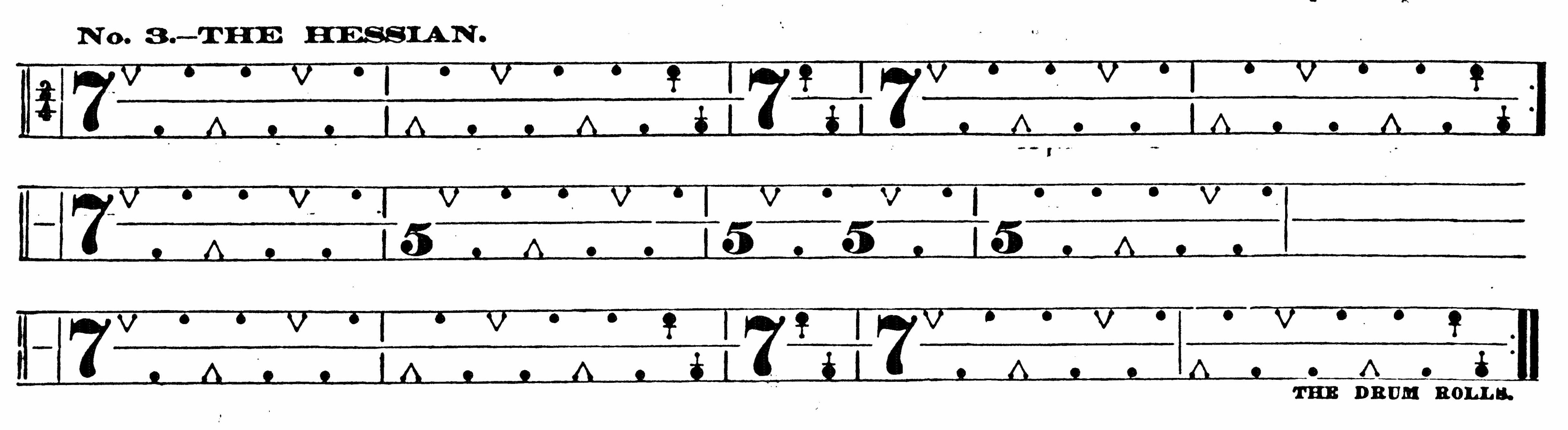
Hart's "Hessian" - 1862
This final example is from “The Drummer’s and Fifer’s Guide” by George Bruce and Dan Emmett, 1862. This is more recognizable as our modern notation. Notice that the shorter 5, 7 and 9 stroke rolls were written out stroke by stroke while the longer rolls were written as we do today.

Bruce & Emmett's "Hessian" - 1862
Buy It Now
$9.95 E-book at Amazon Print version coming soon!
$9.95 E-book at Amazon Print Version coming soon!
