
Grenadier’s Quickstep from “Col. H.C. Hart’s New and Improved Instructor for the Drum“ by Col. H.C. Hart, 1862 has been added to the Resources section under Rudimental Solos. This download includes both the fife and drum part.
Author Archives: Kyle
“Frog In the Well” Added to Growing Resources Collection
“Frog In the Well” is a Civil War tune based on the folk song “Froggie Went A-courting.” The tune first appeared in the 1611 publication “Melismata – Musicall Phansies Fitting the Court, Citie, and Countrey Humours, To 3, 4, and 5 Voyces.” The first line of the lyrics was: “Twas the Frog in the well… And the merry Mouse in the mill.” This version is from “Col. H.C. Hart’s New and Improved Instructor for the Drum” and includes both the fife and drum parts.
“Frog In the Well” – fife and drum
The “Rogue’s March”
This photo was taken in July or August of 1863 at Morris Island, South Carolina. It depicts the practice of “drumming out” (dishonorably discharged) a soldier, always to the tune of “Rogue’s March.” Being drummed out consisted of having the head shaved, the uniform stripped of all buttons and insignia and then paraded in front of the remaining soldiers. In this photo, the man is wearing a sign which reads:
“THIEF. This man, Benj. F. Ditcher, 55th Mass. Vol’s, STOLE MONEY From A Wounded FRIEND.”

The "rogue's march" - drumming a thief out of camp
The tune “Rogue’s March” dates back to at least 1812, where it appears in “A New, Useful and Complete System of Drum Beating” by Charles Ashworth. In comparing 7 different manuals from 1812 – 1862, the music remained unaltered, with the exception of Bruce and Emmett’s version, in which the order was changed.
I have included the drum and fife parts for the “Rogue’s March” from Hart’s manual (1862). Special thanks to Will Chappell for his assistance in deciphering the drum part.
“Rogue’s March” – Fife and Drum Combined, Fife Only, Drum Only. (These will be added to the Resources page.)
A higher resolution of the above image is available from the Library of Congress.
Civil War Drummers
This photo was taken between 1861 and 1865. It pictures three soldiers of the 2nd Rhode Island Infantry in camp with their drums. A higher resolution image is available for download at the Library of Congress website.

Three soldiers in camp with drums
“Rosebud Reel” added to Rudimental Solos
A new page has been added to the growing collection of Rudimental Solos with downloads for “Rosebud Reel.” “Rosebud Reel” is the predecessor of what we now call “Connecticut Halftime.” It appears on page 26 of “Col. H.C. Hart’s New and Improved Instructor for the Drum” by Col. H.C. Hart, 1862. In each of the downloads, a copy of the original “Rosebud Reel” is provided exactly as it appears in Hart’s “Instructor,” as well as the fife part.
Great Buddy Rich Site
Several years ago I discovered an absolute treasure on the internet: Mike James Jazz. He has assembled a collection of 23 live concert recordings of the masterful Buddy Rich laying it down like only he could do. The recording quality of each concert is rated as low, medium or high and notes about most of the concerts are also included. If you’re a fan of the great Buddy Rich, or just want to hear an awesome artist at the top of his game, check out these concert recordings. He also has photos and videos of Buddy as well. Enjoy!
New Resource Added
I’ve just added a new resource to the Care and Maintenance section. “Replacing and Tuning the Snare Head” is now available to view online or download as a PDF. It explains in detail how to remove, replace and properly tune a snare (also called bottom or resonant) head. This is a great resource for students and educators alike.
Second Book Now Available
My second self-published book is now available for purchase. “Quicksteps and Drum Beatings” contains 33 selections from Bruce and Emmett’s “Drummer’s and Fifer’s Guide,” first published in 1862. While its use during the Civil War was probably not common, it does offer a glimpse at the rudimental stylings of the post-Civil War late 1800’s. These arrangements are recommended for beginner to intermediate students.
Available at TheBookPatch.com for $7.95.
Also, please note that I’ve found a less expensive printing service allowing me to lower the price from $10.95 to $7.95 for my first book, “Rudimental Solos for Snare Drum for the Advanced Drummer.”
Strube’s “Three Camps”
My arrangement of Bruce and Emmett’s ” Three Camps” included a change in one of the roll patterns from a 9-stroke roll to an 11-stroke roll. I did this because it flowed better in today’s rudimental style. Turns out Gardiner A. Strube’s version of “Three Camps” from his 1869 manual “Strube’s Drum and Fife Instructor” already did this. I have removed the previous file and replaced it with the Strube version. Thank you Will Chappell for bringing this to my attention.
Three Camps – from “Strube’s Drum and Fife Instructor”, 1869
Ancient Drum Notation
Here’s a look at three examples of how snare drum parts were once notated.
The first example is from “A New, Useful and Complete System of Drum Beating” by Charles Ashworth, 1812. The top notes, with the stems up, indicate the left hand while the bottom notes, with stems down, indicate the right hand. The first measure is a 7-stroke roll.

Ashworth's "Hessian" - 1812
The second example is from “Col. H.C. Hart’s New and Improved Instructor for the Drum” by Col. H.C. Hart, 1862. Again, the upper symbols indicate the left hand and the lower symbols indicate the right hand. The “7” spanning both the upper and lower areas indicates a 7-stroke roll beginning with the left hand and ending with the right. The 5’s in the lower area indicate a 5-stroke roll beginning and ending with the right hand.
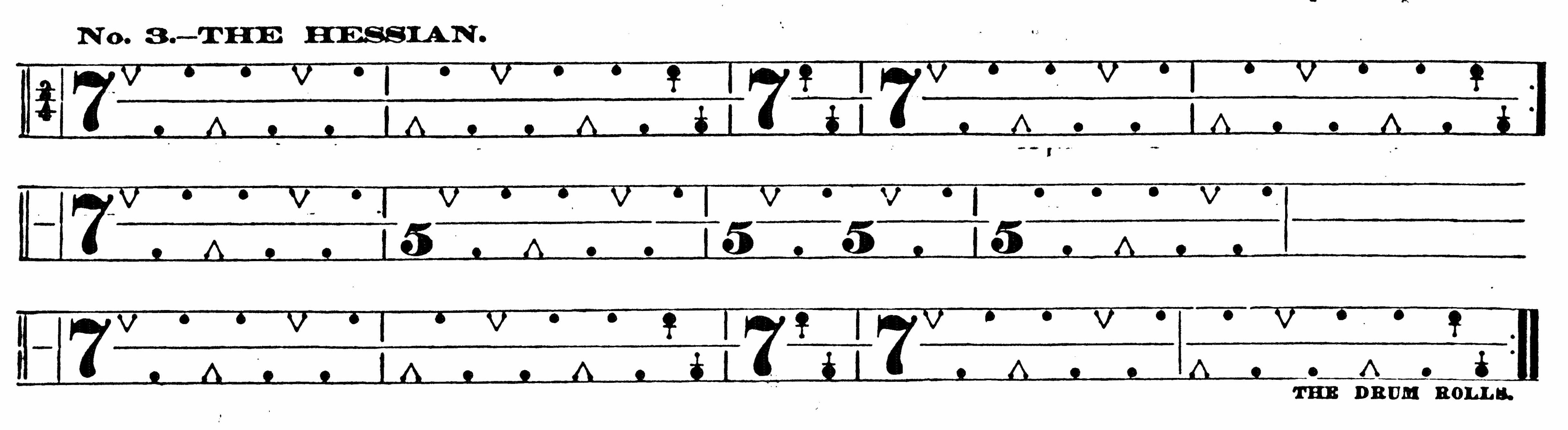
Hart's "Hessian" - 1862
This final example is from “The Drummer’s and Fifer’s Guide” by George Bruce and Dan Emmett, 1862. This is more recognizable as our modern notation. Notice that the shorter 5, 7 and 9 stroke rolls were written out stroke by stroke while the longer rolls were written as we do today.

Bruce & Emmett's "Hessian" - 1862
Buy It Now
$9.95 E-book at Amazon Print version coming soon!
$9.95 E-book at Amazon Print Version coming soon!
